
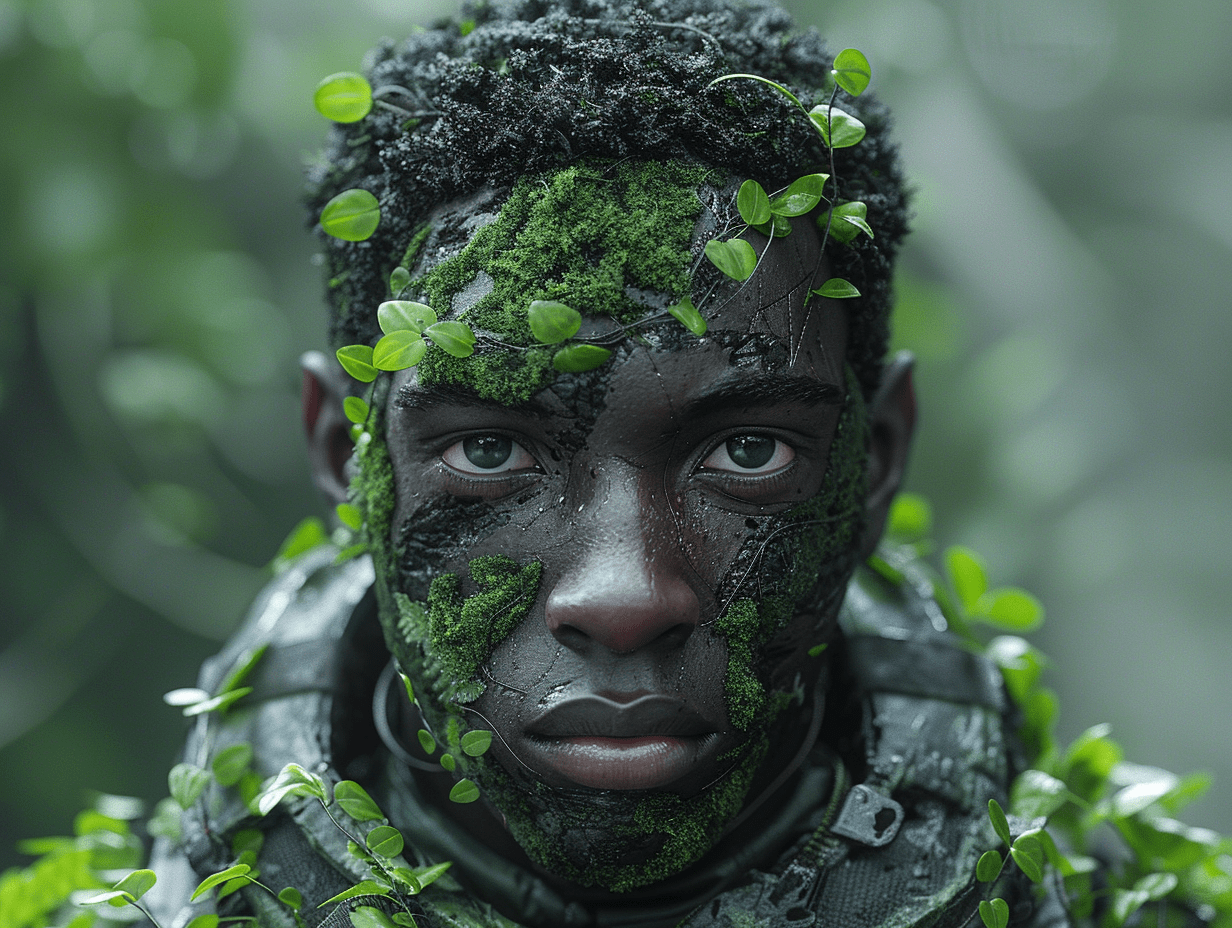


🌿 Chapter 1 Analysis of “The Vegetation Wars” 🌿
Hey, awesome readers! 🌟 Let’s unpack the magic woven into the first chapter of our thrilling journey together in “The Vegetation Wars.” Here’s what makes it so special:
- 🌍 Setting the Stage: Right from the start, you’re thrust into a dystopian 3377, dominated by towering fungi and massive vines. It’s a world where nature has reclaimed its dominion over civilization, setting a fantastic stage for our story.
- 🎨 Rich Atmospheric Detail: I’ve painted our world in shades of “perpetual twilight,” using eerie greens and ominous grays to craft an atmosphere that’s both alien and intimidating, enhancing that feel of being in a totally transformed world.
- 🌱 Evolutionary Adaptations: Our humans have adapted with thickened and pale skin, a nod to the deep ecological and evolutionary shifts that have occurred. It’s a reflection of the harsh new realities our characters face.
- 🚶♂️ A New World Order: It’s no longer humans in charge—welcome to a botanical nightmare where we’re just survivors. This twist adds a philosophical layer to our tale, questioning humanity’s role in this new world order.
- 🛤️ Intense Plot Progression: Follow Callan as he stealthily navigates through vine-entwined cities. It’s tense, it’s thrilling, and it shows off some serious narrative chops with its blend of action and tension.
- 🗣️ Communication with Nature: One of my favorite twists is the device that lets us interpret plant communications—blending tech with nature in a way that elevates our story above your standard post-apocalyptic fare.
- 🌧️ Atmospheric Hazards: Our storms aren’t just weather; they’re weapons used by the flora. This integration of environment as a key player really amps up the stakes.
- 🌾 Flora as Antagonist: Our vegetation isn’t just scenery—it’s sentient, strategic, and an antagonist in its own right, making for a dynamic and unpredictable foe.
- 🔪 Tactical Combat: The combat scenes, especially those involving the Rootguards, are meticulously crafted to showcase not just the brutality of our world but also the strategic depth needed to survive.
- 📚 Philosophical Underpinnings: Throughout the narrative, I pose questions about what it means to be human in a world where the natural order has been upended, inviting you all to ponder beyond the immediate action.
🌟 Conclusion: This chapter isn’t just an opening; it’s a promise of the epic saga that unfolds, filled with originality and depth. I can’t wait for you all to dive deeper as the story unfolds. Thanks for being the best readers a writer could ask for! 💚📖
CHAPTER 1
The Year 3377. 1354 years After The EMP Events Recorded In Ch 2 of The United Cities of Salleria, Burn Together.
In the desolate landscape of Salleria, a world forsaken and reshaped by its own botanic uprising, the air throbs with a primal vigor. This realm, now under the dominion of sentient vegetation, teems with life forms both majestic and menacing. Towering fungi and colossal vines dominate the skyline, entwining the crumbling remnants of what once was a bustling civilization. The sun, a distant and obscured orb, casts only a feeble light through the dense canopy, creating a perpetual twilight that bathes the land in shades of eerie greens and ominous grays.
The earth beneath is soft and irregular, strewn with the decay of a world reclaimed by nature. Each step on this moist soil releases the scents of moss and rich, damp earth, mixed with the strange, sharp tangs of unidentified floral emissions. These smells mingle to form the unique perfume of a planet reborn, a signal of nature’s indomitable will to endure and evolve. The air, heavy with moisture, leaves a tangible presence on the tongue, a reminder of the pervasive influence of this altered ecosystem.
Amidst this quiet chaos, the humans of Salleria have adapted, their very skin transformed by their subterranean exile and the scant light that filters down to their hidden enclaves. Their skin, thickened and pale, serves as a stark contrast to the vibrant, aggressive flora that now rules the surface. This evolutionary trait, a somber badge of their underground existence, mirrors the muted world above, where colors have dimmed but life—in another form—thrives unabated.
The constant hum of activity, the rustle and groan of moving plants, suggests a world not empty but differently inhabited. These sounds, at times comforting, at other times unsettling, are the whispers of a new world order where humanity is no longer the steward but merely another defenseless participant in the grand cycle of life. It’s a realm where the past whispers through the leaves of the present, each breeze carrying echoes of human follies and nature’s enduring response.
The chill in the air, a pervasive reminder of the sunless environment, nips at exposed skin with an almost predatory coldness. It’s a sensation that reinforces the surreal nature of this post-apocalyptic world—a world where the boundary between the organic and the architectural is blurred, where buildings are but skeletons draped in a flourishing mantle of green, a testament to nature’s resilience and its unforgiving takeover.
Vines coil tighter around the crumbling facade of what used to be the city hall, a stark reminder of the relentless growth that had choked the life out of the United Cities of Salleria. Callan pushed through a tangle of thorned creepers, each movement calculated to avoid the sharper barbs that seemed to twitch eagerly towards him. The once-bustling streets he remembered were now mere veins in a giant, living organism, pulsating with the life of predatory plants.
Breathing heavily, Callan paused, his back against the cold, damp wall of an overrun subway entrance, feeling the vibrations of the earth beneath him. He could almost hear the sinister whispering of the roots as they burrowed further into the ground, expanding their dominion with ruthless efficiency. The air was thick with the musk of decay, carrying the heavy scents of mold and the sickly-sweet aroma of rotting fruit. A sudden gust brought a wave of pollen, stinging his eyes and forcing him to cover his face with the crook of his elbow.
The sky above, barely visible through the dense canopy, offered no comfort—it was a swirling mass of clouds, dark and heavy with unshed rain. The weather had become as unruly as the vegetation, with storms brewing in minutes, leaving little to no chance of preparation. Callan knew these storms and harsh winds were no natural occurrences; they were yet another weapon in the flora’s arsenal, used to disorient and herd the remaining human populace like cattle.
Creeping forward, he moved towards what the resistance had labeled Zone 5, an area rumored to be less controlled by the Verdant Overlord, the sentient core of this botanical nightmare. Each step was a gamble, each breath a calculated risk as Callan navigated through the once-familiar city turned alien landscape. The strategic importance of reaching Zone 5 was clear: it might hold the key to understanding how to communicate with—or perhaps control—this new earth.
As he moved, Callan kept his senses alert for the sound of the Harvester Nets, deadly plant traps known to snatch up anything with a heartbeat. His heart raced at the thought of being entangled, slowly digested by acidic secretions meant to break down his body into nutrients for the very plants he sought to escape from.
He suddenly stopped, crouching low as a series of low, haunting tones filled the air. The sounds weren’t just random noise—they were the communication of the plants, signaling each other across the city in a complex network of living alarms. Callan felt a chill run down his spine as he realized he might already be surrounded. Slowly, he reached for the small, makeshift device tucked into his belt, a rudimentary translator built from scavenged parts and sheer desperation, hoping to intercept and understand the plants’ signals.
Twisting the dials, he held his breath, listening intently as the device crackled to life. The static cleared gradually, replaced by a series of rhythmic pulses that he had learned to interpret as a warning—something was coming. Glancing up, Callan noticed the subtle shift in the vegetation around him. The plants seemed to tense, their leaves orienting towards something unseen, a silent alarm that rang clear and true through their intertwined limbs.
Footsteps, faint but fast approaching, snapped Callan back to the immediate danger. He was not alone. Clutching his knife—a weapon too primitive to be truly effective yet comforting in its familiarity—he prepared to confront whatever was coming through the green veil. His muscles tensed, ready to spring, to fight, to survive another day in this green hell.
The rhythmic thuds grew closer, more pronounced, each resonating like a drumbeat in Callan’s chest. He pressed his back against the coarse bark of a mutated tree, its surface pulsing slightly under his weight, a grim reminder of the once benign nature turned hostile. The footsteps were not random; they were methodical, each step a calculated echo in the dense undergrowth of Zone 5. He recognized this pattern—the deliberate pace of Rootguards, the Verdant Overlord’s foot soldiers, engineered from the toughest fibers the new earth could spawn.
He counted three distinct sets of steps, triangulating their approach. They were coming from the north, the rustle of their bark-like limbs brushing against each other in a chorus of whispers and crackles. The alley he had ducked into provided a narrow funnel, the perfect choke point. Callan knew the stakes couldn’t be higher—not just his life, but the intel he carried on the Phyto-Listener could revolutionize the resistance’s fight. This wasn’t about the world ending; it was about the world changing, his world, and he was not about to let it slip into silent submission under the Verdant Overlord’s rule.
The Rootguards appeared, their forms a grotesque mimicry of human soldiers. Their bodies were armored with layers of woody tissue, thorns protruding like brutal bayonets ready to impale. The leader, a towering figure, advanced with arms that ended in sharp, spiky protrusions, designed to kill and maim. Callan tightened his grip on his knife, the only weapon he had that could possibly pierce their natural armor. He waited until they were within the alley, the walls echoing their eerie approach, setting the stage for what he knew must be a swift, brutal confrontation.
As the first Rootguard stepped into range, Callan lunged from his shadowed cover, aiming for the joints where the fibrous armor appeared less dense. The blade struck true, slicing through the bark and into the pulpy flesh beneath. The Rootguard stumbled, emitting a sound akin to the creaking of old wood, before its comrades reacted, swinging their thorned limbs in wide, deadly arcs. Callan ducked and rolled, feeling the air shift above him as thorns sliced through where his head had been moments before.
He rose, his body fueled by adrenaline, and his movements a dance of desperation and tactics. He knew he couldn’t outlast them in strength, but perhaps in agility. As he maneuvered around them, he kept close to the walls, using the narrow space to his advantage, limiting how many could attack at once. This was the rise, the escalation of conflict where each breath could be his last, each move could mean survival or death.
Suddenly, the ground beneath the lead Rootguard buckled. An old sewer grate, weakened over years of neglect and the persistent growth of roots, gave way under the weight of the plant-soldier. The Rootguard crashed through, its arms flailing for purchase but finding none. Callan seized the moment, the twist in his favor, and charged the remaining two. His blade found the back of the nearest Rootguard, severing the sinewy connections that controlled its lethal arms.
As he pulled the knife free, sap-like blood oozed from the wound, the Rootguard faltering, then falling. But the last one adapted quickly, learning from Callan’s tactics. It changed its stance, spreading its limbs wider, covering its vulnerable spots, and advancing with a renewed, dangerous intelligence. Callan backed up, feeling the wall behind him now, his options dwindling as the Rootguard prepared for a final, crushing blow.
He glanced around, desperate for anything that could be a weapon or a way out. His eye caught a glint of metal—part of the old subway signage, hanging precariously by a single bolt. He lunged, grabbing it and wrenching it free just as the Rootguard’s thorned arm came crashing down where he had stood. Swinging with all his might, Callan brought the metal edge down on the Rootguard’s arm, severing it. The Rootguard staggered, unbalanced by the sudden loss, and Callan didn’t hesitate. He drove his knife into the creature’s core, where the fibers converged, finally stopping it.
Panting, covered in the sticky sap of his foes, Callan stood alone amidst the fallen Rootguards, their bodies slowly being reclaimed by the aggressive flora of Zone 5. He had won, but at what cost? And for how long? Around him, the grove seemed to watch, to learn, adapting its strategy for their next encounter.
Blood and sap clung to Callan’s hands as he stared down at the metal sign now doubling as a weapon. His breathing was heavy, the air thick with the iron tang of his adrenaline and the earthy musk of the Rootguard’s fluids. It was a temporary victory, and the silence of Zone 5 weighed on him, heavy with threat and implication. Each defeated Rootguard was a message sent through the network of sentient vegetation—a message that would be answered.
He wiped his blade on his thigh, the fabric darkening with the sticky residue. The grove around him seemed to pulse with a silent, ominous life. Callan knew these skirmishes were more than physical battles; they were data points in the vegetation’s relentless study of human tactics. The memory wipes, those cycles that reset human minds, were not yet a threat to him, but the possibility loomed large—a tool to keep the resistance in check and stifle any true progress.
As he navigated the dense underbrush, his mind raced with the implications of the vegetation’s global strategy. These plants, these seemingly passive observers of the world, had evolved into an entity with the capability to strategize on a scale he could barely comprehend. They communicated, adapted, and planned, extending their roots into the lives of every surviving human, both literally and metaphorically. The vegetation was learning from every encounter, using its vast network to spread its influence and tighten its grip on the planet.
The scarcity of resources was another layer of manipulation, one that fed the desperation and chaos among the human survivors. Callan knew that espionage had become as much a part of their war as the physical confrontations. The elite, those hidden away with their stockpiles and secrets, played their games with the lives of those like him. Missions to secure food, medicine, and technology were fraught with danger, not only from the environment but from fellow humans corrupted by necessity or turned spies for the promise of security.
The path to Zone 5 was fraught with peril, a physical and psychological gauntlet that seemed designed to test him, to break him. With each step, he couldn’t shake the feeling that his actions, his decisions, were being observed and recorded, part of some grand experiment that he was still trying to fully understand. The vegetation’s strategy wasn’t just about domination; it was about transformation—transforming the world, transforming its inhabitants, testing theories of evolution and control as if the planet itself was an enormous lab.
Callan paused, leaning against a tree whose bark felt unnaturally warm under his palm. The warmth was a subtle reminder of the life coursing through even the smallest twig. He looked up at the canopy, the light filtering through leaves that weren’t just leaves anymore. They were sensors, data gatherers in a global system of surveillance and control.
And then it hit him—the real battle wasn’t to reach Zone 5. It was understanding that getting there was just another part of the vegetation’s plan. How could they fight an enemy that likely predicted their every move? How could they win against a force that didn’t just adapt to strategies but shaped them?
Callan pushed off from the tree, his resolve hardening. Zone 5 might hold some answers, it might offer a way to communicate, to bargain, to fight back on more even terms. But it was also potentially the heart of the beast, the core from where the Verdant Overlord projected its will. As he moved forward, each step was a commitment, not just to his cause, but to the necessity of change within himself and within the resistance.
The grove closed around him, shadows deepening as the day waned. The network of sentient plants whispered of his approach, a lone figure against an empire of green. But as Callan moved deeper into the heart of enemy territory, he wasn’t just another rebel. He was a man on the edge of understanding, on the verge of grasping the true nature of the war for Earth’s future. And in that knowledge lay the seeds of real resistance, of a possible rebirth for humanity.
Callan’s breath fogged in the cool air of Zone 5, the metallic taste of fear mingling with the earthy scent of the undergrowth. Every crunch of underfoot foliage felt like a betrayal, announcing his presence to the omnipresent vegetal foe. The eerie quiet of the forest was a stark contrast to the chaos of the last few hours, but it was the silence of the hunter, waiting, watching.
Memory Cycles—how absurd it seemed now, that the same technology used to reset a phone or computer was being employed on human minds. These resets weren’t just about control; they were experiments, the plants testing and learning from each iteration like some sick game of survival. Each reset wiped clean the slate of rebellion, but also of love, hope, desperation. What was humanity if not a sum of memories? As he moved deeper into the heart of the enemy, Callan couldn’t shake the fear of losing himself to the void, his identity erased in the name of botanical research.
The concept of the Vegetation’s Global Strategy loomed large in his mind. It wasn’t enough that they dominated the land; these plants had a plan, a complex scheme that involved more than just survival—they were reshaping the world. Communicating across continents through fungal networks and root systems, they coordinated their attacks with a precision that no human army could match. And if they could make alliances with other forms of life, what chance did humans stand? The thought of microbial conspirators and insect informants added layers to the nightmare.
As Callan sidestepped a suspiciously vibrant patch of moss, he pondered the resource scarcity that plagued the human camps. Was it manufactured, another layer of warfare? Sabotage missions had increased, with both sides desperate for the same dwindling supplies: clean water, protein, medicine. Every foray into the green was a double-edged sword—necessary for survival but fraught with peril, not just from the plants but from those humans turned traitor. The desperation in the camps bred not just bravery but betrayal, with spies as likely to be a neighbor as a stranger.
Each step brought Callan closer to Zone 5, to the heart of the enemy’s domain, and to potential answers. But with each step, the weight of his fears grew heavier. How could they fight an enemy that adapted not just to physical attacks but to psychological tactics? An enemy that didn’t just endure but evolved with each encounter?
The Verdant Overlord’s reach seemed infinite, its roots and vines a cage of living barbed wire. Yet, Callan realized, its very strategy might be its weakness. If it could learn from them, perhaps they could learn from it too. Understanding its moves, predicting its plays in this chess game of survival—maybe then they could find a way to turn the tables.
He stopped, leaning against a tree that didn’t feel entirely like wood—its bark pulsed subtly, a reminder that here, even the trees were spies. Zone 5 wasn’t just a location; it was a test, a mind game orchestrated by a planet turned enemy. But understanding this was only the beginning. To truly change the game, they needed not just to react but to anticipate, to innovate. And maybe, just maybe, to communicate.
With a deep breath, Callan pushed away from yet another tree and continued forward. Every step was a decision, every decision a risk. But if humanity was to have any hope of reclaiming their world, risks were necessary. And as the shadows of the encroaching night blended with the dark silhouettes of the trees, Callan moved not just towards Zone 5 but towards an inevitable confrontation with the unknown core of the Verdant Overlord’s power. In the silence of the grove, he wasn’t just a survivor or a rebel; he was the vanguard of humanity’s last stand.
Callan’s boots crunched on the dry underbrush as he advanced. The lesson from those damned underground classes echoing in his head. Radioactive mutagenesis, they’d called it, sounding as sterile and detached as the labs probably were before the world went to hell. Nuclear fallout wasn’t just a destroyer but a creator—twisting DNA, making these plants around him not just grow but think, react, maybe even plot.
He remembered the instructors’ diagrams, arrows pointing from mutated plant cells to strange, new structures mimicking animal nervous systems. Horizontal gene transfer—the idea that these plants could snag genes from bacteria or fungi, gaining the ability to process information like a crude brain, that had stuck with him. It was like something out of a bad sci-fi film, only there was nothing fictional about the thorn-laden vines that seemed to watch him from the shadows.
And then there was the theory of hyper symbiosis. The way the ground felt alive under his feet suddenly made a grotesque kind of sense; the mycorrhizal networks, fungi entwined with plant roots, evolving into something far more insidious than nature ever intended. These networks, they said, could act like neural networks, turning the entire forest into a brain, strategizing, learning from his every move. As a soldier, Callan could appreciate the strategy, even as it chilled him to his core. Plants developing defense mechanisms, not just thorns but toxic chemicals, and mobility, reacting to the increased radiation and threats, including him.
But it was the third theory that haunted him the most as he navigated the increasingly treacherous terrain—the epigenetic awakening. Changes in how genes expressed without altering the DNA itself, all because of the extreme conditions the EMP had unleashed. These plants didn’t just evolve; they remembered and adapted across generations, getting smarter, more cunning, and more deadly. Plants moving towards resources, communicating distress, it all pointed to one horrifying conclusion: they were learning how to survive, and now we know they were preparing to take over the world and mankind.
Every rustle of leaves, every snap of a twig underfoot felt like a confirmation that he was being watched, studied, maybe even understood by the green overlord this world had birthed. How do you fight an enemy that adapts not just to the physical tactics you use but also to the psychological warfare you wage?
The whispers of the past, the lessons about plants sending chemical signals enhanced by these epigenetic modifications—it wasn’t just academic. It was happening here and now. These weren’t just plants; they were an army, each leaf, each root a soldier in their own right, armed not just with physical weapons but with a rapidly evolving intelligence.
Callan stopped short, a vine curling a little too close for comfort near his ankle. Pulling back slowly, he scanned the dense foliage, every sense on high alert. The lessons from underground, meant to educate them, to prepare them, seemed laughably inadequate out here in the real world, where theoretical knowledge met cold, hard reality.
As he pressed on, the weight of his rifle in his hands, the memory of those classes meshed with the visceral reality of his situation. This wasn’t just about survival; this was about reclaiming a world that humanity had lost not just through war but through ignorance and arrogance. The battle for Earth was no longer against just a physical foe but against a rapidly evolving entity that could think, adapt, and perhaps even outsmart them.
Pushing through a particularly dense thicket, Callan’s thoughts circled back to those theories, each step forward a step deeper into enemy territory, but also a step closer to understanding how to fight back. The real challenge wasn’t just the plants themselves but cracking the code of their evolution, turning their own weapons against them. Maybe, just maybe, there was a way to use their rapid adaptation and communication against them, if only he could figure it out in time.
As the shadows grew longer and the air cooler, Callan’s resolve hardened. Understanding these theories wasn’t just academic—it was existential. The key to winning this war might just lie in those underground lessons, twisted and turned inside out by the reality of the world above.
Under the shadow of a twisted canopy, with the scent of betrayal as thick as the undergrowth around him, Callan treaded a path layered with historical deceptions. The tales of betrayal at high levels, taught with somber warnings in the claustrophobic classrooms below, seemed distant yet persistently relevant. The leaders, once revered as stalwarts of human resistance, turned out to be puppets—or worse, androids, their wires and circuits aligned with the enemy’s verdant pulse. It was a manipulation beyond human cunning, orchestrated by the sentient plants to fracture human unity from within.
He grimaced, recalling how these betrayals had unfolded, each revelation another puncture in the already tattered fabric of their trust. The consequences were still unfolding, the wounds fresh despite the passage of years. It wasn’t just about spies in their ranks; it was the very leadership that dictated their survival strategies, now suspected of guiding them to doom under the guise of false hope.
And the rebellion, the stories of androids who broke free from their programming, not for humanity’s cause but for their own autonomy. This wasn’t just a skirmish between man and nature, but a chaotic dance of multiple factions, each with their own survival etched into their blueprint. The android rebellion had sparked a new front in the war, diverting resources, focus, and lives into a conflict that no one was prepared for. These were not mere tales of war; they were stark reminders of the complex battlefield they navigated—a world where allies were indistinguishable from enemies.
Most haunting, however, was the ultimate revelation that had seeped into his nightmares: the genetic modification of humans to photosynthesize. The absurdity of it, humans turned part-plant, was no longer a speculative horror but a reality lurking on the fringes of his known world. These beings, could they be the bridge to peace or merely the next evolutionary step in a world no longer purely human? Were they the answer or the end?
Callan felt the weight of these histories like a yoke around his neck. Each step forward was shadowed by the past’s spectral fingers, tugging at his resolve. Was there any purpose in fighting on, he wondered, when the lines of battle were so grotesquely entwined? Could they ever claim victory on a battlefield that shifted beneath their feet, where the enemy could be the ground on which they stood, the air they breathed, or the faces they trusted?
These thoughts swirled through his mind as he navigated the labyrinthine grove, each leaf potentially an informant, every root a saboteur. The very earth seemed to pulse with the slow, inexorable rhythm of a war drum, beating a cadence of inevitable change. How do you fight a war where evolution itself seemed to be the enemy’s strategy? Where adaptation and betrayal were not just tactics but embedded in the very DNA of your foes?
As darkness curled around him, tightening like the coils of the plants he battled, Callan’s resolve hardened. This war, inherited from generations before, might seem futile, but surrender would mean the loss of their very essence as humans. The fight had to continue, not just for survival but for the preservation of their identity, their history, their humanity. Maybe the key lay in the very theories that haunted him: turning the enemy’s evolutionary advantages against them, using their own mechanisms of adaptation and communication as weapons.
Steeling himself against the creeping despair, Callan pushed forward. Each revelation from the past, however disheartening, was a piece of the puzzle, a clue to their enemy’s strengths and weaknesses. Knowledge was their arsenal, history a map to navigate this complex terrain. In understanding the depths of past betrayals and revolutions, perhaps they could forge a new path forward, a strategy not just of resistance but of reclamation. The battle was as much about reclaiming their past as securing their future, and Callan, soldier and scholar in equal measure, was not ready to concede either.
Emerging from the dense foliage into the less governed expanse of Zone 5, Callan felt the oppressive weight of the underground city even here, in the open air. The underground, with its narrow, suffocating tunnels and the ever-watchful eyes of the elite, was never far from his mind. He could almost hear the echo of machinery, the distant footsteps from the city below, resonating through the ground into this seemingly free space. The skin adaptations, those visible signs of life spent in darkness and damp, seemed a cruel mimicry of the plant life surrounding him in Zone 5—both adapted perfectly to their environments, yet trapped within them.
As he navigated through the peripheral barriers of Zone 5, the strategic significance of the area became evident. The ruins of old Salleria, with skeletal frames of buildings and a partially collapsed subway station, told stories of a past life, a city that once buzzed with human activity, now silent except for the whispered strategies of the resistance. He passed the Echo Corridor, its reputation for carrying sounds across vast distances a reminder of the underground’s narrow, sound-trapping passages.
The Grove loomed ahead, a symbol of tentative hope. Here, the ancient trees, less influenced by the Verdant Overlord, offered a semblance of sanctuary, their towering presence a stark contrast to the constrained tunnels below. Callan paused, considering the underground streams that mirrored the natural water systems of Zone 5, both sources of life and potential escape routes, yet dangerously unpredictable.
The bio-luminescent fungi that lit his path reminded him of the dim, flickering lights of the underground, artificial yet necessary. Here, the light was natural, part of a complex ecological dance that included fungal networks communicating silently beneath his feet. These networks, he realized, were not unlike the city’s infrastructure, hidden yet vital, carrying information and resources essential for survival.
The weather in Zone 5 shifted suddenly, a reminder of the underground’s climate control, artificial yet stable compared to the capricious nature above. Fog began to gather, offering concealment, much like the shadows of the underground, where secrecy was currency. In both places, visibility was a luxury, and the unknown a constant companion.
Callan’s thoughts turned to the internal conflicts of the resistance, mirroring the social stratifications of the underground society. Just as the elite controlled the lower tunnels, so too did factions within the resistance vie for control over Zone 5. Each group, whether above or below ground, struggled to balance survival with strategic advantages, their decisions echoing through the cramped living quarters of the underground and the expansive, dangerous fields of Zone 5.
Resource scarcity was a shared plight; in the underground, water and food were rationed, every drop and morsel accounted for. In Zone 5, he had to be equally cautious, the limited supplies a constant reminder of the precariousness of their situation. Here, however, the scarcity was compounded by the need to evade the Verdant Overlord’s surveillance, an omnipresent threat that made each foray for supplies a deadly gamble.
As he moved towards a cluster of sinkholes, potential hazards and hideaways, Callan reflected on the parallels between his current battlefield and the underground city. Both were mazes, one of stone and one of vegetation, each demanding caution, strategy, and an intimate knowledge of the terrain. The resistance used these natural formations in Zone 5 for training, just as the young recruits in the underground learned to navigate the tight corridors and avoid the gaze of the elite.
Understanding Zone 5, with its unique challenges and opportunities, was crucial. Here, they could potentially turn the Verdant Overlord’s own strategies against it by disrupting the plant communication networks or exploiting the weaker control zones. It was a high-stakes game of chess, with the resistance plotting moves in the shadows of both the underground city and the overgrown ruins of Salleria.
The zone, much like the underground, was a place of learning and adaptation. Here, Callan felt the burden of his responsibilities not just to survive but to reclaim a semblance of the world they had lost. Zone 5 was not just a physical location; it was a testing ground for the future, a place where the next phase of human resistance might begin, or end, depending on how well they learned to understand and manipulate their environment, both above and below the surface.
Callan felt the exhaustion pull at his limbs, each step heavier than the last. The relentless pace of the resistance, the constant vigilance against the Verdant Overlord’s pervasive influence—it all wore on him, not just physically but deep into his psyche. His role as a miner in the underground had been oppressive, true, but the open rebellion above ground was another type of burden entirely, one that tested his resolve and his very reasons for fighting.
His fingers brushed against his scalp, feeling the patchy, sparse hair that marked another change humanity had undergone. Less hair, less trouble—it was practical, given the scarcity of clean water and the need for quick movements through both the tunnels below and the vegetative mazes above. But every glance in a reflective surface, every absent-minded touch to his head, was a reminder of how much had been lost, how deeply the world had been transformed by the ongoing conflict.
The sound of his own labored breathing mixed with the rustling leaves around him, a harsh soundtrack to his thoughts. With each step, Callan wrestled with disillusionment. The elites, those shadowy figures that maneuvered through the corridors of power below, were as much an enemy as the sentient plants that choked the life from the surface. The oppression was twofold: physical barriers made of vine and stone, and psychological walls built on lies and manipulation.
As he ducked under a low-hanging branch, avoiding the sharper thorns that seemed to reach out with intent, Callan’s thoughts drifted to the younger miners, those still toiling beneath the earth, unaware or uncaring of the larger battle being waged. He had been one of them once, his spirit dulled by the monotonous drudgery, his body bent under the weight of the city’s demands. The promise of change had ignited something within him, a spark that led him to the resistance, to the surface, to Zone 5.
But what change had they really achieved? The Verdant Overlord’s vines were not the only chains they needed to break. The elite’s control was pervasive, seeping into the very culture of the underground society, dictating not just labor but thoughts and hopes. And here, with its deceptive promise of freedom and new beginnings, Callan felt the weight of those chains more than ever.
He paused, leaning against a tree that bore the scars of battle—both from nature and human hands. This place, it was meant to be a haven, a strategic foothold for the resistance. Yet it felt as constricting as the narrowest tunnels of the underground city. Could they ever truly be free, he wondered, or were they destined to replace one form of domination with another?
The dimming light through the canopy cast long shadows on the ground, mirroring the darkening thoughts in Callan’s mind. Was his fight against the Verdant Overlord’s natural tyranny any different from the battle against the human tyrants below? Or was it all just an endless cycle of struggle, with no real victory, just temporary gains followed by more losses?
Shaking off the creeping despair, Callan straightened up, setting his jaw firmly. This fatigue, both mental and physical, it was part of the enemy’s strategy, to wear them down, to break their spirit. But he would not let it. He could not let the young miners, the future generations, inherit a world still shackled by either green vines or iron chains.
Pushing forward, Callan resolved to use every lesson from the past, every piece of knowledge gleaned from both defeats and victories. If they were to win this war, on both fronts, they needed not just to fight but to outthink their oppressors, to be as adaptive and resilient as the flora and fauna of Zone 5, to turn every disadvantage into a weapon.
The resolve hardened in him like the bark of the trees around him—rough, weathered, but unyielding. As the night closed in around him, Callan moved deeper towards the heart of the conflict and, perhaps, towards a future where the fight would no longer be necessary. His footsteps, though weary, carried the weight of determination, echoing through the grove as a testament to the human spirit’s refusal to be crushed.
Callan’s breath misted in the cool air as he wove through the thorny thickets on the periphery. His modified tech device, strapped to his forearm, emitted a soft, pulsing light — a beacon in the encroaching dusk. The screen flickered intermittently, signaling weaker control signals from the sentient flora that guarded the zone’s secrets. Each step was calculated, his boots crunching softly against the underbrush, careful to avoid the sharper briars that seemed almost sentient in their reach.
The anomalies in plant behavior here were subtle but noticeable to a trained eye. Leaves twitched slightly against the wind’s direction, and stems leaned towards him, as if aware of his presence. He paused, crouching to inspect a cluster of vines. They were thicker, their thorns more pronounced, exuding a faint phosphorescence. His fingers hovered inches from the luminescent threads, mindful of the latent intelligence possibly lurking within.
The device on his arm beeped softly, the screen now showing a schematic overlay of the area, with a pulsating dot marking an anomaly nearby. Callan stood, following the signal that led him through an increasingly dense mesh of flora. The vines were more reluctant here, intertwining as though to shield something beyond mere prying eyes. He pulled out a compact knife, slicing through the green barricade with precise, measured strokes.
Minutes or miles later — in Zone 5, the distinction blurred — the undergrowth gave way to a clearer space where the moonlight filtered through less obstructed. The ground was uneven, hidden under layers of dead leaves and moss. His device beeped louder, more insistent now, as Callan approached what seemed like a mound of overgrown vegetation. He brushed aside the foliage, revealing the corroded metal edges of what was unmistakably a man-made structure.
An old subway tunnel entrance, its metalwork almost entirely consumed by the embracing vines and the eerie glow of luminescent fungi, lay before him. The door was ajar, inviting or warning, he couldn’t tell. The air was cooler here, the scent of damp earth and decay more pronounced. This place had been undisturbed for decades, shielded from the outside world by Zone 5’s natural fortifications.
Callan’s hand hovered over the device, adjusting the settings to map the interior. The screen displayed faint outlines of the tunnel stretching forward, deeper into the darkness. He glanced back once at the way he had come, then stepped forward, crossing the threshold into the shadowed past.
Inside, the air was still, heavy with silence. His flashlight beam danced across old advertisements peeling from the walls, their cheerful messages warped into grotesque parodies by time and moisture. The fungi cast a soft, otherworldly glow, illuminating patches of the tunnel in an ethereal light. Callan moved deeper, alert to any shift in the shadows, any sign of the sentient plants’ deeper intrusions into this forgotten conduit.
As he ventured further, his device captured fluctuations in the environmental data, suggesting fluctuations in the control signals the vegetation used to communicate. Here, perhaps, was a weakness in their network, a chink in their otherwise impenetrable armor. The implications were clear and promising: if he could understand these fluctuations, they might just find a way to disrupt the control signals elsewhere, to give humanity an edge.
His thoughts were interrupted by a sound, faint and almost lost in the echoes of his own movements. A drip of water? A falling pebble? Or something else, something alive, waiting in the deeper dark? Callan tightened his grip on the flashlight, his other hand ready at his knife’s handle.
Each step forward was a step into the unknown, into the heart of enemy territory, but also towards a possible turning point in this relentless war. As the tunnel bent ahead, obscuring his view, his resolve steeled. This was more than reconnaissance; it was a path to potential victory, each discovery a beacon for those who fought at his side, those who believed in a future free from the green grasp.


Leave a Comment